
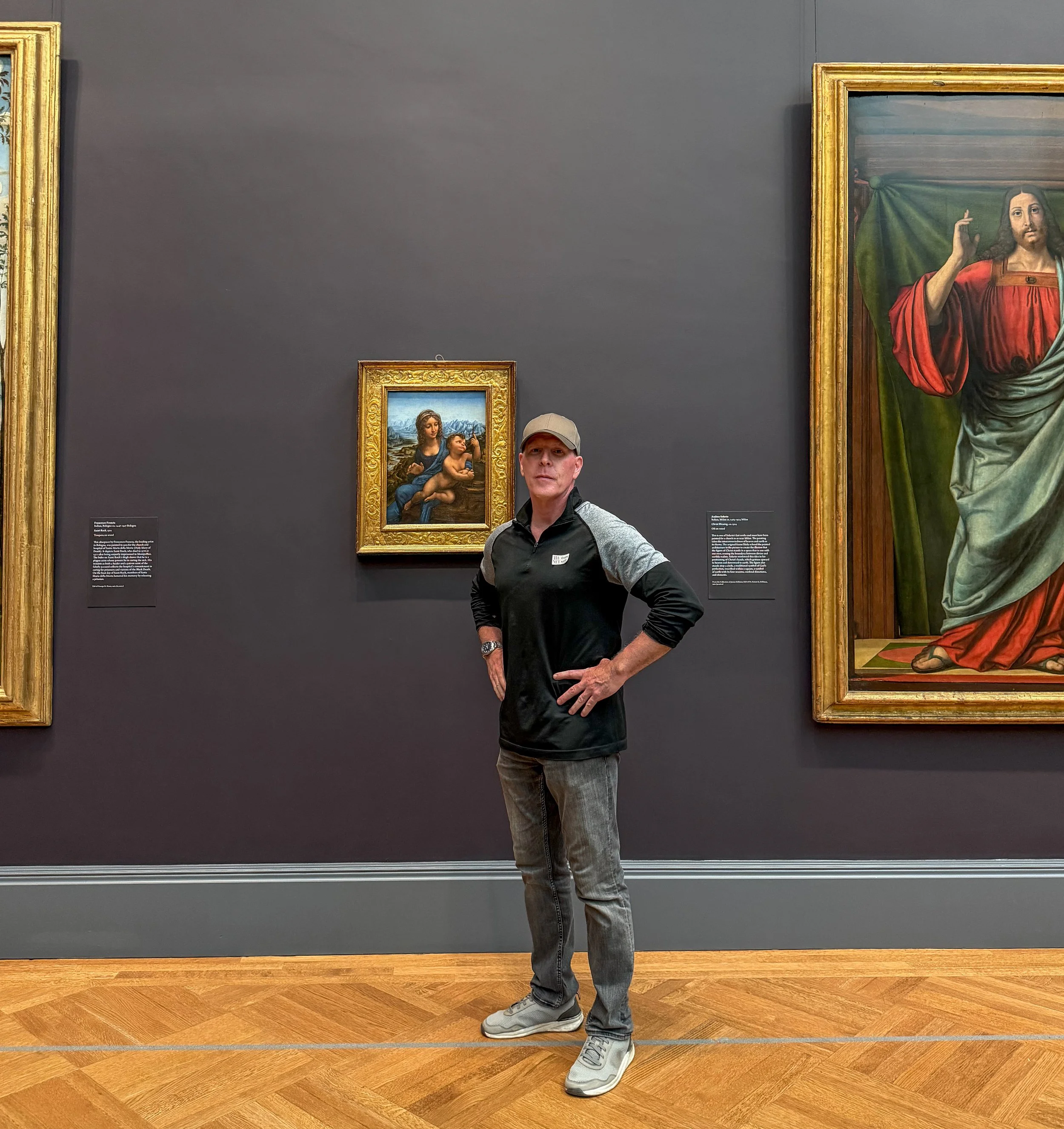
What struck me immediately about seeing this relatively small da Vinci painting (just 19½ × 14⅝ inches) was how vibrantly colorful it appeared. Leonardo's works are notorious for their unfinished states, damages, and alterations by overpainters, retouchers, and incompetent restorers. This one was a rare exception.
I had first learned through an Instagram account I follow, @themetwanderer, that the Madonna of the Yarnwinder went on display unceremoniously at the Metropolitan Museum of Art. I was excited to get there as soon as I could.
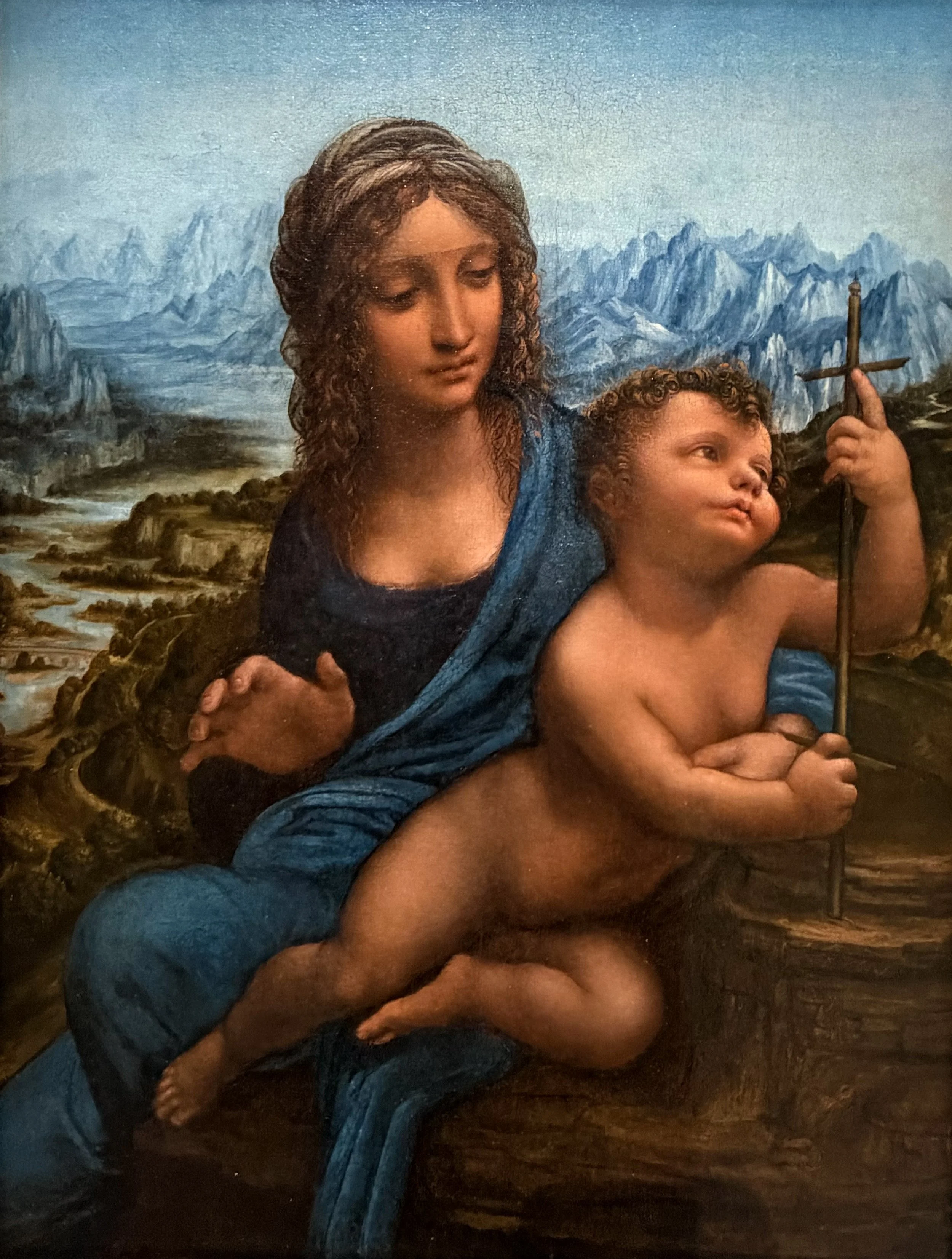
Several copies of this composition exist, but the Lansdowne Madonna is one of two that art historians believe Leonardo and/or his immediate circle created around the turn of the 16th century. The other, the Buccleuch Madonna, possibly shares its origins, and both are named after former British owners. The composition’s theme centers on the Christ child stretching toward the yarnwinder shaped like a crucifix, and thereby foreshadowing his fate, while Mary wraps her arm around him as if trying to keep him from it.
As I studied the Lansdowne in Gallery 609, I took on the role of amateur scholar. The mountains receding from a luminous blue to a faint, whitish hue are consistent with Leonardo's own writings on aerial perspective, yet something about their execution instilled some doubt. They seemed to lack da Vinci’s characteristic refinement.


“Painter, when you make mountains, ensure that from hill to hill the bases are always lighter than the summits.”
As @themetwanderer wrote in her post, the Lansdowne and Buccleuch versions "sit at the center of one of the great attribution debates in Leonardo scholarship." That’s certainly borne out by two da Vinci scholars who land on different sides of these debates.
In Leonardo da Vinci: The Complete Paintings, Frank Zöllner asserts that while Leonardo designed the Lansdowne version, it must be a workshop product "carried out largely by an assistant," while the original, painted for the secretary to the king of France around 1501, must be "considered lost."
Martin Kemp, writing in Leonardo by Leonardo, contends that Leonardo clearly had a hand in both versions, pointing to his characteristic revisions in the underdrawings, where the child's pose and hands were altered. Kemp even speculates that Leonardo may have worked on both paintings simultaneously in his workshop. He considers the composition a turning point for da Vinci: "No other artist had previously executed Madonna and Child works equaling the intense storytelling in which Christ prophetically and physically embraces his crucifixion. Michelangelo and Raphael certainly took notice."
Interestingly, the Met appears to come down on Kemp’s side. The placard in the gallery attributes the work to Leonardo and his workshop. The Lansdowne was held for decades by an anonymous New York private collector and its loan was made possible “by the Kenneth C. Griffin Collection.” In my exchange with @themetwanderer, she mentioned overhearing that it "will be on view for two years."
This marked the fourteenth painting, out of approximately 20 extant works, that I've seen attributed wholly or in part to da Vinci. Whatever scholars ultimately decide about the Lansdowne Madonna, the thrill of standing in front of it isn’t up for debate.